1
Clay sculpt
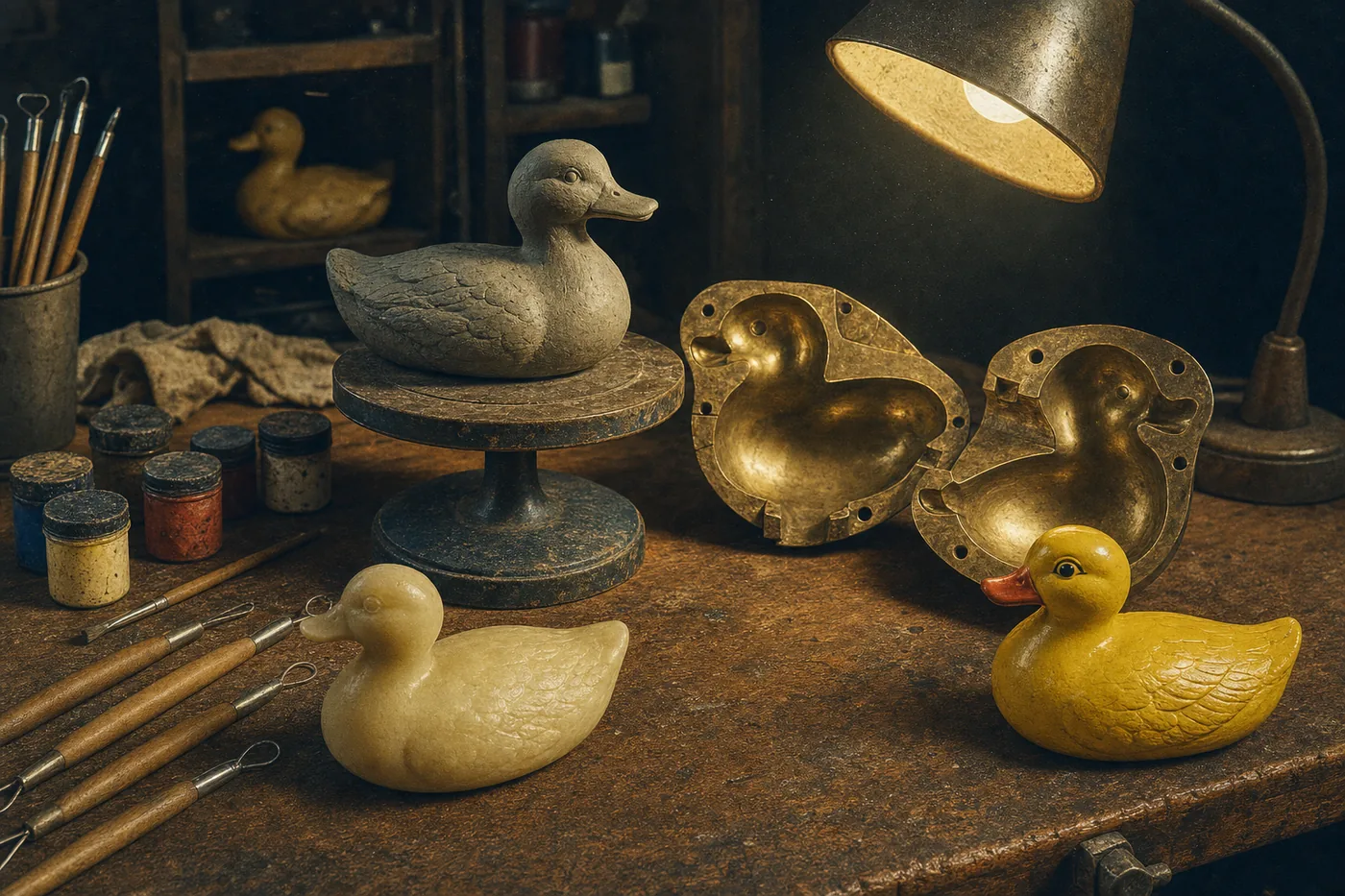
2–3 working days. Your artwork becomes a hand-sculpted clay original. Shape changes happen here, while the piece is still soft and no tooling exists.
Custom molding is a manufacturing project, not an order form. Your duck starts as a lump of clay and ends as an electroformed brass mold running on a rotocasting floor. Here is every step, what it takes, and where the go/no-go gates are.
2–3 working days. Your artwork becomes a hand-sculpted clay original. Shape changes happen here, while the piece is still soft and no tooling exists.
3 working days. A silicone mold is taken off the clay, a blank mock-up is cast, and a colored mock-up follows so you see the piece painted before anyone commits to metal.
11 working days. A wax copy is pulled, dusted with conductive powder, and hung in an electrolytic tank where brass grows onto it — five days for the master mold, five more for the production molds.
About 45 working days. Once you approve the PVC pre-production sample: rotocasting, spray paint, hand-painted detail, packing, delivery.
Nothing here is skippable and nothing here is machined out of a steel block. Soft vinyl ducks come off electroformed brass molds, and brass molds are grown, not cut. That is the part that takes the time.
| Step | What happens | Time |
|---|---|---|
| 1. Design artwork | Your reference art is turned into a production drawing with sizes, colors, and paint breakdown | Before the clock starts |
| 2. Clay sample | The original is sculpted by hand in clay — this is where shape revisions belong | 2–3 days |
| 3. Silicone mold | A silicone mold is taken directly off the approved clay original | 1 day |
| 4. Mock-up sample | A blank casting pulled from the silicone so the form can be checked in the round | 1 day |
| 5. Colored mock-up | The mock-up is painted to your colors — your first look at the finished piece | 1 day |
| 6. Wax sample | A wax copy is cast, the piece that will actually become the mold | 1 day |
| 7. Electroforming | The wax is coated in conductive powder and suspended in an electrolytic tank, where copper and brass plate onto its surface: one master brass mold, then a set of production molds pulled from that master | 5 days + 5 days |
| 8. PVC sample | A real production-material sample off the real production mold. This is the hard approval gate | 1 day |
Vinyl and electroplating both shrink, and they shrink predictably. A shop that does not compensate for it hands you a duck that is noticeably smaller than the one you approved.
About 45 working days for the full run, through the shop in sequence. Soft vinyl pieces are rotocast; hard plastic pieces run on a separate injection line.
Liquid vinyl is charged into the brass production molds and spun while it cures, building an even wall from the outside in. Thirty rotation machines run the floor, so a large order runs on many molds at once instead of queueing on one.
Base coats and body colors are sprayed in the paint department, one color pass at a time, with each pass cured before the next.
Faces, eyes, trim, and the small details that make a character read as that character are painted by hand at the bench. This is the step that separates a collectible from a giveaway.
Pieces are counted and packed to your spec: bulk case-pack, polybag with header card, or retail window box.
Freight booked to your dock or split across multiple ship-to addresses, on the date the schedule committed to.
16–18 working days to go from clay to an approved PVC sample, plus about 45 working days for the production run. That is roughly 61 to 63 working days of actual shop time, which lands right around 90 days on a calendar. Nobody grows a brass mold faster than the tank grows it. A supplier promising a from-scratch custom duck in a month is either decorating a stock body or about to miss your date in front of your CMO.
Not at the first email. The 90 days runs from the moment the production drawing is signed off, and it pauses whenever a sample is sitting in someone's inbox waiting for approval.
Your brass production molds already exist, so a repeat run goes straight to the rotocasting floor — about 45 working days instead of the full calendar, with no clay, no wax, and no tank time.
The colored mock-up and the PVC pre-production sample are both stop-and-approve points. If the piece is wrong, it gets fixed there instead of 2,000 times over.
Ninety days from approved artwork to delivered ducks. The shop time breaks down as roughly 16 to 18 working days from clay sample to an approved PVC pre-production sample — clay sculpt, silicone mold, mock-up, colored mock-up, wax sample, then ten days in the electrolytic tank growing the master and production brass molds — plus about 45 working days for the production run. That is around 61 working days of real shop time, which is where the ninety-day calendar comes from. We do not quote a shorter calendar than we can actually hold.
Two thousand pieces per size. Each size needs its own dedicated set of electroformed brass molds, so a program in both the 2-inch and the 3-inch is 2,000 of each. Every Nash Ducks duck is sculpted and tooled from scratch for one client, and that tooling only makes economic sense across a real run. If you need fewer than 2,000, a from-scratch mold is the wrong tool and we will tell you so.
The tool is built for your shape and held for your reorders. Once it exists, repeat runs skip sculpt and tooling entirely, which is why the second order on a shape is dramatically cheaper than the first.
Designed in Nashville, Tennessee and produced in China. The sculpt is developed and art-directed here; the clay original, the electrolytic tank, the brass molds, and the rotocasting floor are at our dedicated molding partner overseas. Nash Ducks runs the whole program from Nashville: we develop the sculpt and revisions, hold both approval gates, ship you the physical colored mock-up and PVC pre-production sample to sign off on in hand, and coordinate paint, packaging, and freight. You deal with one company in your own time zone from concept art to delivered pallets.
The sooner the sculpt starts, the sooner the tool exists. Send reference art and a target date.